
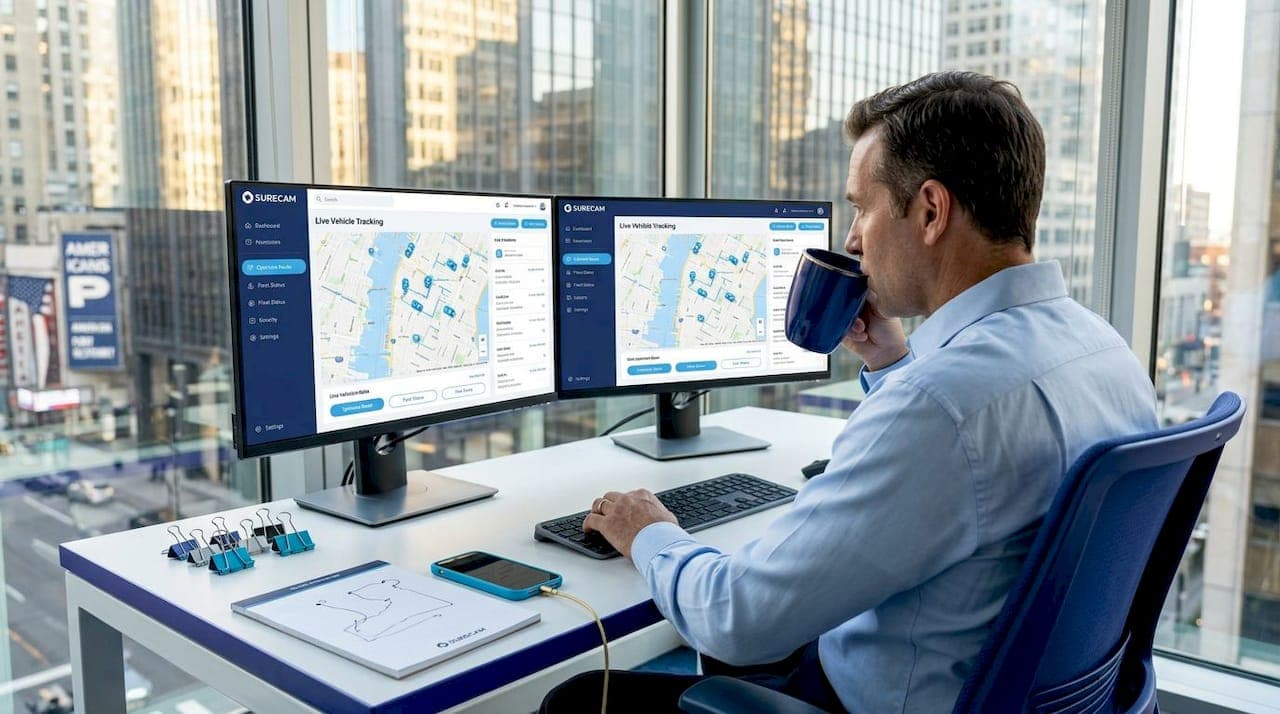
Most fleet managers assume commercial fleet tracking is just a dot on a map. That assumption is costing them money, safety incidents, and operational control every single day. Modern fleet tracking systems combine GPS, telematics, AI-powered cameras, and cloud analytics into a single platform that does far more than show you where your trucks are. This article breaks down exactly what commercial fleet tracking is, how it works, the real business benefits it delivers, and the one factor most fleets overlook that determines whether the technology actually pays off.
Table of Contents
- What is commercial fleet tracking?
- How commercial fleet tracking works: Technology and features
- Key benefits for fleet owners and managers
- Challenges and best practices for successful adoption
- What most fleet managers miss: Why people matter more than technology
- How SureCam supports your fleet tracking journey
- Frequently asked questions
Key Takeaways
| Point | Details |
|---|---|
| Fleet tracking defined | Fleet tracking uses GPS, telematics, and video to monitor vehicles for better safety and efficiency. |
| Benefits realized | Proper implementation brings cost savings, compliance, and improved driver safety. |
| People over tech | The biggest challenge is often driver buy-in and privacy, not the technology itself. |
| Adoption best practices | Clear policies and communication are key for successful fleet tracking rollouts. |
| Integrated solutions | Combining video and GPS delivers the most actionable insights and accountability. |
What is commercial fleet tracking?
Commercial fleet tracking is the real-time monitoring of your vehicles, drivers, and assets using a combination of GPS hardware, telematics sensors, and data analytics software. It's not just location data. It's a continuous stream of operational intelligence that tells you what your vehicles are doing, how your drivers are behaving, and where your biggest inefficiencies are hiding.
At its core, the system works like this: a small device installed in each vehicle collects data from the engine, GPS satellites, and onboard sensors. That data transmits to a cloud platform where managers can view live dashboards, receive automated alerts, and pull detailed reports. Add a connected dash cam, and you layer in visual evidence for every trip, incident, and driver interaction.
Core functions of commercial fleet tracking include:
- Live vehicle location and route history
- Driver behavior monitoring (speeding, harsh braking, rapid acceleration)
- Engine diagnostics and fault code alerts
- Geofencing and arrival/departure notifications
- Electronic logging device (ELD) compliance support
- Integrated video footage from in-cab and forward-facing cameras
- Fuel consumption reporting and idle time tracking
The data's role in logistics has grown dramatically over the past decade, and fleet tracking is now central to how commercial operators make daily decisions about routing, maintenance, and staffing.
| Feature | Basic tracking | Advanced tracking |
|---|---|---|
| Live GPS location | Yes | Yes |
| Route history | Yes | Yes |
| Driver behavior alerts | Limited | Full detail |
| Engine diagnostics | No | Yes |
| Video integration | No | Yes |
| AI safety insights | No | Yes |
| Cloud reporting | Basic | Advanced analytics |
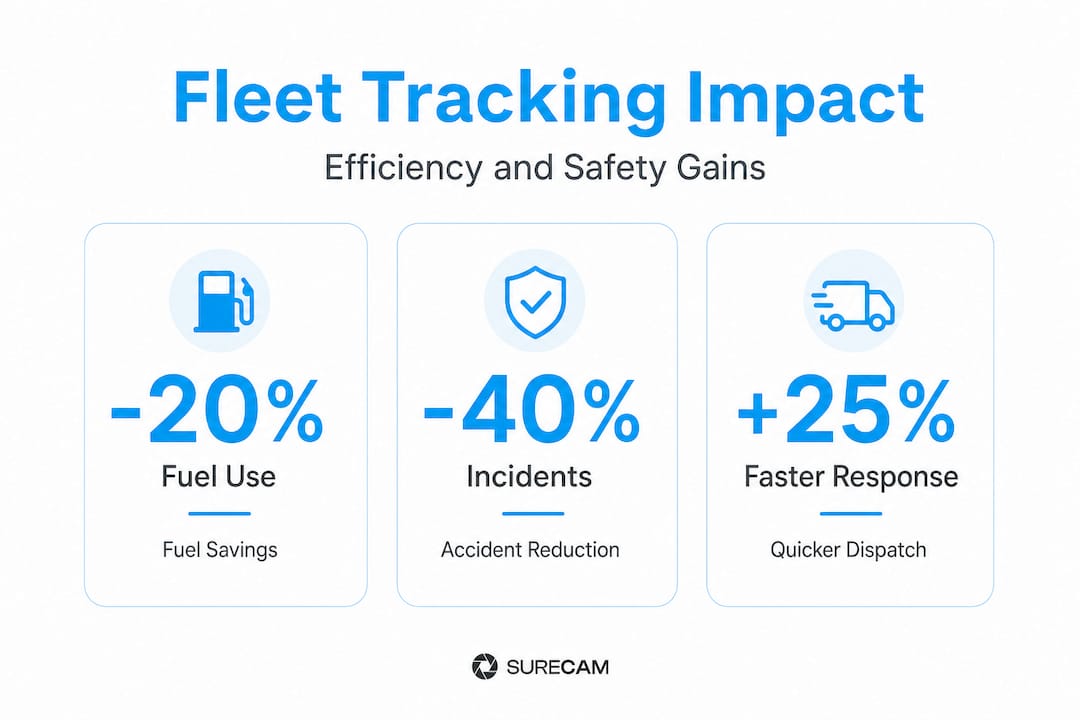
One critical factor that separates successful deployments from failed ones is how you handle the human side of the rollout. Privacy and usage-policy clarity can determine whether fleets realize expected benefits, even when the technology is accurate. Following communication best practices from day one sets the foundation for genuine adoption rather than quiet resistance.
How commercial fleet tracking works: Technology and features
Now that you know what fleet tracking is, let's break down how these solutions actually work and what to look for when evaluating your options.
Every modern fleet tracking system starts with an onboard GPS unit. This device communicates with satellites to pinpoint the vehicle's location, typically updating every few seconds. That location data streams to a cloud platform, where managers can view a live map of their entire fleet at any moment.
Telematics goes several layers deeper than GPS alone. The onboard device taps into the vehicle's CAN bus, which is the internal communication network that controls everything from the engine to the brakes. This connection allows the system to record precise driver behavior data: how hard a driver brakes, how often they exceed the speed limit, how long the engine idles while parked at a job site, and whether seatbelts are fastened.
What telematics captures in real time:
- Speed and acceleration patterns
- Harsh braking and cornering events
- Idle time and engine-on hours
- Fuel consumption per trip and per driver
- Diagnostic trouble codes from the engine
- Seatbelt usage and distracted driving alerts
Video telematics adds a camera layer that changes everything for safety and incident management. When a harsh braking event triggers, the system automatically saves the video clip from seconds before and after the event. Managers don't have to guess what happened. They can watch it. This is especially valuable for construction and field service fleets where vehicles operate in complex, high-risk environments.
Cloud platforms tie it all together. Alerts go out automatically when a driver speeds through a school zone, when a vehicle enters or leaves a job site, or when an engine fault code appears. Trend reports show you which drivers need coaching and which routes are burning the most fuel.
Pro Tip: Integrating video and GPS in a single platform means you never have to cross-reference two separate systems when investigating an incident. One timestamp, one clip, one location. That saves hours of administrative work per event.
Fulfillment process insights from logistics operations show that connected data systems reduce error rates and speed up decision-making across the board. The same principle applies directly to fleet management.
It's worth acknowledging that privacy concerns and monitoring discomfort are real factors to weigh when deploying telematics. Understanding balancing privacy and safety is not optional. It's a core part of building a system your drivers will actually accept. For a solid grounding in the operational side, reviewing fleet management essentials gives managers a practical framework to work from.
Key benefits for fleet owners and managers
Understanding the technology and features, we can now explore the real benefits these tools bring to day-to-day fleet operations and how to make sure you actually realize these gains.
1. Fuel and maintenance cost reduction
Idling is one of the most wasteful habits in commercial fleets. A single truck idling one hour per day can burn through hundreds of gallons of fuel per year. Fleet tracking identifies the worst offenders instantly. Route optimization further reduces miles driven, cutting fuel spend without sacrificing service coverage. Predictive maintenance alerts from engine diagnostics catch problems before they become breakdowns, saving thousands in emergency repair costs. Saving fuel with GPS tracking is one of the fastest ways to generate measurable ROI from a tracking investment.
2. Improved driver safety and accountability
Camera-verified events change the coaching conversation. Instead of telling a driver they had three harsh braking events last week, you can show them exactly what happened and why it matters. This shifts the dynamic from discipline to development. Drivers who understand the data and see themselves on video tend to self-correct faster than those who receive only a written warning.

3. Faster response and better customer service
When a customer calls asking where their delivery is, you have an instant answer. When a field service technician is running late, dispatch can reroute the nearest available crew in seconds. Real-time visibility eliminates the guesswork that frustrates both customers and managers. Shipment tracking benefits show that customers who receive accurate ETAs report significantly higher satisfaction scores.
4. Easier compliance and insurance reporting
ELD compliance, hours of service (HOS) logging, and IFTA fuel tax reporting all become far less painful when the data is captured automatically. Insurance carriers increasingly offer premium discounts for fleets that use telematics and video, because the data proves safer driving patterns and provides clear evidence in the event of a claim.
Statistic callout: 40% of fleets reported initial driver resistance during rollout, according to a Verizon Connect fleet survey. That number drops significantly when managers communicate the "why" behind the technology before deployment begins.
Pro Tip: Don't just tell drivers what the system tracks. Explain why it matters for their safety, their job security, and the company's ability to defend them if they're ever involved in an accident that wasn't their fault. That context changes everything.
Avoiding the pitfalls of poor rollout is just as important as choosing the right hardware. Implementation challenges are well-documented, and fleets that address them proactively see far better outcomes than those that treat deployment as a pure IT project.
Challenges and best practices for successful adoption
Even the best technology can fall short if it isn't adopted well. Here's how to sidestep the biggest pitfalls.
The most common reason fleet tracking deployments underdeliver is not a technical failure. It's a people failure. Drivers who feel surveilled rather than supported will find ways to game the system, ignore the data, or create a culture of resentment that undermines the entire investment. Driver pushback and unclear policies can prevent fleets from realizing expected benefits even when the technology is working perfectly.
Best practices for a successful rollout:
- Write a clear, written tracking policy before you install a single device
- Explain exactly what data is collected, who can access it, and how it will be used
- Hold a pre-launch meeting with drivers to answer questions and address concerns
- Involve a driver representative in the planning process if possible
- Commit to using data for coaching, not just punishment
- Review data regularly in one-on-one sessions, not just when something goes wrong
- Celebrate improvements publicly and recognize safe drivers
"Adoption nuances matter: even when technology is accurate, lack of driver trust or unclear policies can mean fleets never realize expected benefits." This isn't a soft concern. It's a hard business risk that directly affects your return on investment.
Data security is another area that deserves serious attention. Drivers and managers both have a legitimate interest in knowing how vehicle and behavioral data is stored, who can access it, and how long it's retained. Building these answers into your policy from the start prevents confusion and builds credibility.
Effective driver communication is a skill that pays dividends across every aspect of fleet management, not just tracking rollouts. And if you're working through the early stages of a new system, overcoming adoption challenges provides a practical roadmap for getting your team aligned quickly.
What most fleet managers miss: Why people matter more than technology
Here's the uncomfortable truth that most fleet technology articles skip right past: the dashboard doesn't drive the results. Your drivers do.
Every feature comparison, every hardware spec, every AI alert is only as valuable as the human behavior it changes. A fleet that installs the most advanced video telematics system on the market but fails to build driver buy-in will see modest improvements at best. A fleet with a slightly simpler system and a culture of open communication will outperform it every time.
We've seen this pattern repeatedly. Managers invest in technology expecting it to solve a safety or efficiency problem automatically. When the numbers don't move, they blame the vendor. But the real gap is almost always in how the system was introduced and how the data is being used day to day.
The most effective fleet managers treat tracking data as a coaching tool, not a surveillance report. They sit down with drivers and say, "Here's what the system showed last week. What do you think caused that? What can we do differently?" That conversation is where the real improvement happens.
Privacy and driver rights are not obstacles to tracking. They're part of the framework that makes tracking sustainable. Drivers who feel respected and informed are far more likely to drive safely, report accurately, and stay with your company long term.
Start with people and policy. Then choose your technology. That sequence matters more than any feature on the spec sheet.
How SureCam supports your fleet tracking journey
Ready to put what you've learned into practice? SureCam builds fleet camera systems specifically for commercial operators who need more than just a location dot on a screen.
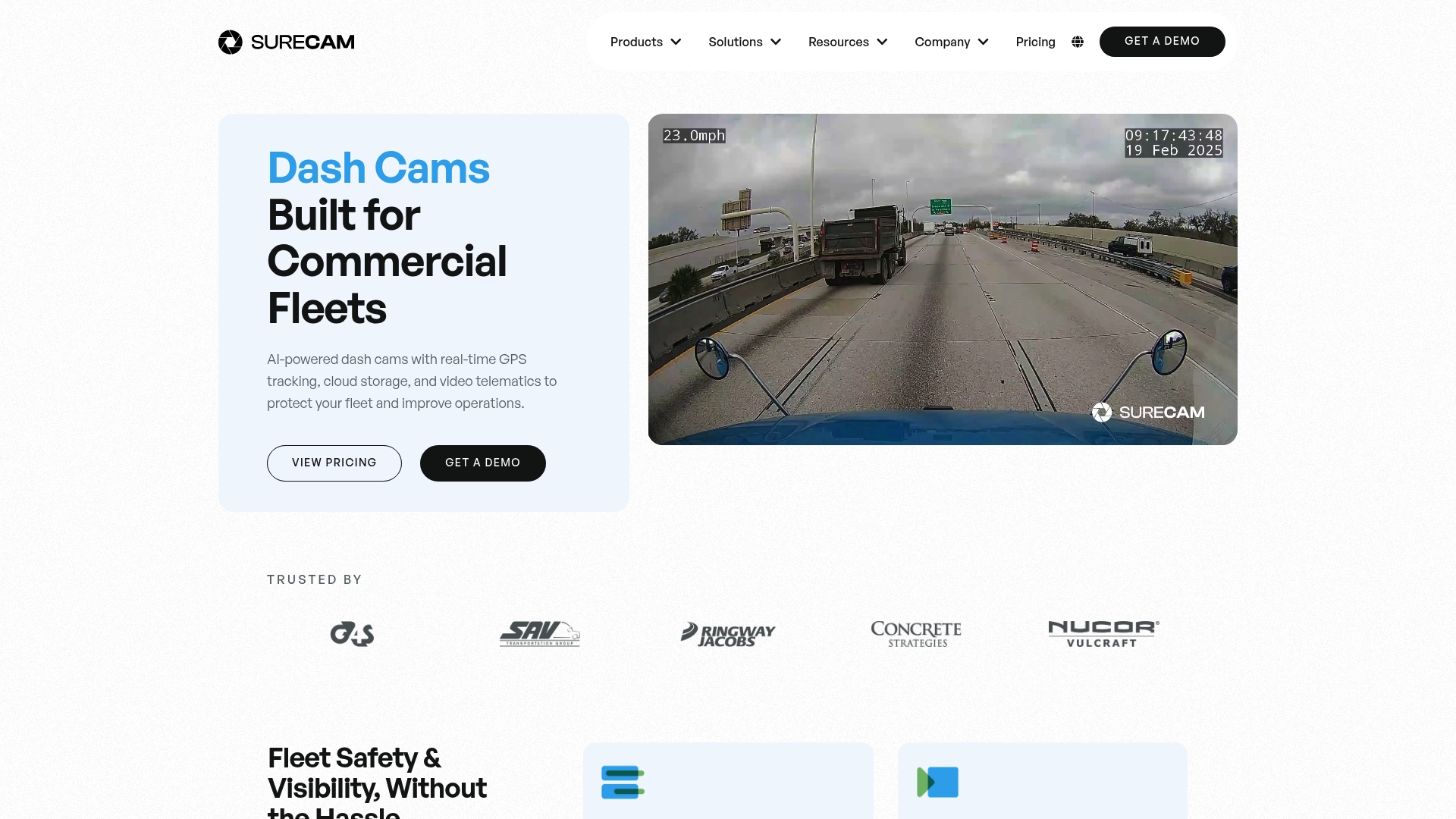
SureCam's integrated video and GPS platform gives you real-time footage, AI-powered safety alerts, driver coaching tools, and cloud-based reporting in one connected system. Whether you're managing a construction fleet dealing with high-risk job sites or a field service operation that needs proof of every customer visit, SureCam has purpose-built solutions designed for your environment. Explore improving fleet safety with smart camera systems, or see how SureCam addresses the specific needs of solutions for construction fleets. Business owners looking for a broader operational picture can also explore solutions for business owners to see how integrated telematics supports growth and accountability across the entire fleet.
Frequently asked questions
Is fleet tracking legal and does it impact driver privacy?
Fleet tracking is legal in the US and most regions, but employers must create clear policies and communicate data usage openly. Privacy and policy clarity directly affect whether drivers accept the system and whether the fleet realizes its expected benefits.
How soon can businesses see ROI from commercial fleet tracking?
Most fleets report measurable operational savings within the first few months, particularly in fuel costs and incident response times. ROI accelerates when drivers are actively engaged in the rollout rather than resistant to it, since 40% of fleets face initial pushback that can slow down results.
What is the difference between GPS tracking and video telematics?
GPS tracking tells you where a vehicle is and how it's being used in terms of speed and route. Video telematics adds camera-based evidence that shows exactly what happened during any event, giving managers far better context for coaching, insurance claims, and incident investigation.
How can fleet owners prevent driver resistance to tracking technology?
Open communication before deployment, a written policy that explains data usage clearly, and using tracking data for coaching rather than punishment are the three most effective strategies. Driver pushback and unclear policies are the leading reasons fleet tracking investments underperform, making proactive communication a business-critical step.