

Choosing the wrong dash cam system is one of the most expensive mistakes a fleet operation can make. Not because the hardware costs too much, but because a camera that lacks the right features quietly drains your budget through missed exoneration opportunities, unresolved driver behavior issues, and data gaps that your insurance carrier notices before you do. Generic consumer dash cams were never built for the demands of commercial fleets, and treating them as a viable option often leads to compliance headaches and operational blind spots that grow with every vehicle you add to the road.
Table of Contents
- How to evaluate fleet dash cam features
- Top fleet dash cam features to look for
- Comparison of leading dash cam setups by fleet size
- Feature comparison table: must-haves vs. nice-to-haves
- Our expert take: small details that drive big value
- How SureCam can help you build a safer fleet
- Frequently asked questions
Key Takeaways
| Point | Details |
|---|---|
| Prioritize must-have features | Focus on multi-angle video, real-time alerts, and robust driver coaching tools. |
| Tailor to fleet size | Choose integrated platforms for large fleets or standalone dash cams to avoid excess costs for small operations. |
| Test in your environment | Pilot dash cam solutions with your own vehicles to catch tuning needs and integration gaps before rollout. |
| Value reliable support | Responsive support and easy repairs are as critical as feature lists for long-term ROI. |
How to evaluate fleet dash cam features
Before you compare products side by side, you need a framework that maps features to your actual operational goals. Are you focused on driver coaching? Incident exoneration? Fuel efficiency through route behavior? Compliance with DOT standards? Each objective shifts your feature priority list in a meaningful way, and skipping this step is how fleets end up with expensive systems that answer the wrong questions.
The core selection criteria for any commercial fleet boil down to five pillars:
- Video quality and coverage (resolution, field of view, night performance)
- System reliability and uptime (crash-proof recording, loop storage, tamper resistance)
- Data access and speed (cloud sync, live streaming, event upload priority)
- Driver privacy controls (in-cab recording policies, data retention limits)
- Integration with existing fleet tools (ELD systems, routing software, maintenance platforms)
Understanding dash camera essentials is the first step toward building a system that actually holds up in real-world conditions. Real-world conditions include edge cases that most product demos never show you. For example, false positives in DMS (driver monitoring systems) are more common than vendors admit. A driver reaching for coffee can trigger a phone-use alert. A mirror check can register as distraction. Urban environments introduce GPS drift that mis-tags incident locations. And permanent adhesive mounts, while secure, can complicate windshield replacements in ways that add unexpected downtime costs.
The strongest telematics best practices all share one thing: they treat the evaluation process as an ongoing conversation between hardware capabilities and fleet-specific workflows, not a one-time vendor selection event.
Pro Tip: Before committing to a large-scale rollout, run a pilot with at least five to ten vehicles that represent your most challenging operational environments. Test GPS accuracy in your actual urban corridors, trigger DMS alerts deliberately to check tuning options, and confirm that your IT team can pull video data within the timeframes your safety protocol requires.
Top fleet dash cam features to look for
With your evaluation criteria in place, here is where the real decisions happen. Modern fleet dash cams have evolved far beyond simple loop recorders. The best systems function as mobile data platforms that generate safety intelligence, not just footage.
HD multi-angle recording is non-negotiable. A single front-facing camera misses too much. Dual-facing cameras capture both the road and the cabin, giving you the context needed to distinguish a reckless driver from a defensive one. Rear-facing and side-channel options matter even more for large commercial vehicles like flatbeds and tankers, where blind-spot incidents are the most common and expensive claims.
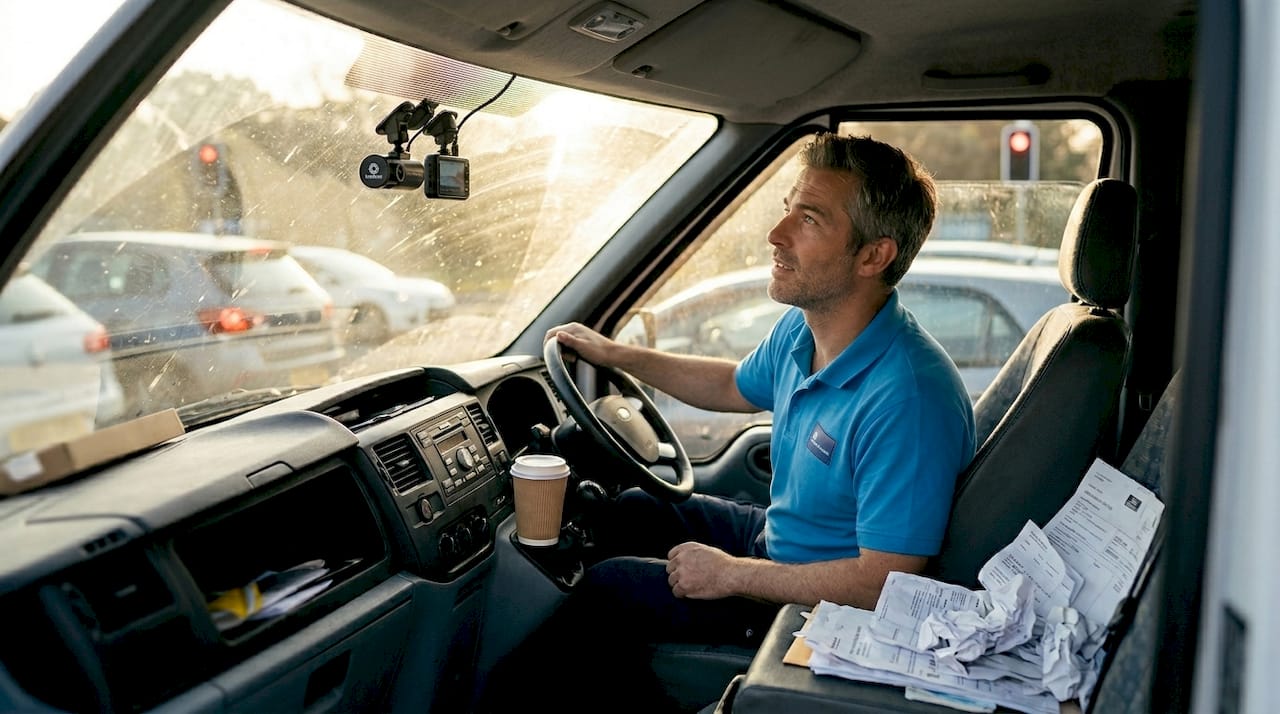
Dual-band GPS deserves far more attention than it typically gets in vendor comparisons. Standard GPS in dense urban environments can drift by dozens of meters, placing an incident in the wrong block or even the wrong intersection. That detail matters enormously when you are defending a driver in a legal dispute or trying to correlate a harsh-braking event with a specific road hazard.
Driver monitoring systems (DMS) use AI to detect drowsiness, distraction, seatbelt non-compliance, and handheld device use in real time. The key word is "tunable." A system that cannot be adjusted for your specific fleet conditions will generate alert fatigue, which is arguably worse than no alerting at all. Drivers and safety managers start ignoring notifications, and the system loses its effectiveness entirely.
Cloud connectivity and live streaming are what separate a dash cam from a fleet intelligence tool. Real-time access to video means your safety manager can review a reported incident within minutes rather than waiting for a vehicle to return to the yard. For long-haul operations especially, this capability is the difference between a controlled response and a reactive scramble.
Automated driver coaching tools are where modern systems earn their subscription costs. Look for platforms that offer automated scorecards, risk-prioritized event reviews, and positive reinforcement mechanisms. Automated scorecards and event prioritization significantly streamline exoneration workflows, and data shows that 91% of fleet managers use dash cam footage specifically for driver exoneration. Daily and weekly scorecards create a feedback loop that coaches behavior without requiring a safety manager to personally review every clip. You can learn more about how professionals handle dash cam video management to see how these workflows play out at scale.
Incident exoneration workflows need secure video retention with tamper-evident storage. If footage can be deleted or overwritten before a legal hold is applied, your camera system is a liability, not an asset. Look for systems that automatically flag and preserve incident video to a protected cloud partition the moment an event is detected.
Third-party telematics integration is where fleet managers often underestimate complexity. Your dash cam needs to talk to your ELD, your routing platform, your maintenance scheduler, and ideally your insurance portal. Without this, you are managing parallel data streams that never fully align, and the analytical value of your footage drops sharply.
GPS fleet tracking integration specifically matters for correlating video events with route data, which helps safety managers identify high-risk road segments rather than just high-risk driver moments. That shift from individual to environmental analysis is where serious fleet safety programs operate.
Pro Tip: When evaluating DMS features, ask the vendor to show you their false positive rate across your specific industry vertical. A system tuned for long-haul trucking behaves very differently from one calibrated for urban delivery or utility service vehicles.
Comparison of leading dash cam setups by fleet size
Understanding which features matter most leads directly into selecting the best solution setup for your fleet's scale and operational budget.
The fleet dash cam market splits cleanly into two categories: subscription-based integrated platforms and standalone camera systems. Neither is universally superior. The right choice depends entirely on fleet size, technical capacity, and how your safety program is structured.
Subscription platforms excel for large fleets with 500-plus vehicles where integrated ELD and telematics capabilities justify the per-unit monthly cost. For fleets under 50 vehicles, standalone cameras often deliver better cost-per-vehicle economics while still covering core recording and basic alert functions. An example taxi fleet platform illustrates how even smaller operations structure their camera and dispatch integration, though the feature depth differs significantly from enterprise-grade solutions.
| Fleet size | Recommended setup | Key strengths | Primary trade-off |
|---|---|---|---|
| 1 to 50 vehicles | Standalone cameras | Lower total cost, simple setup | Limited data automation |
| 51 to 200 vehicles | Hybrid or mid-tier platform | Scalable analytics, moderate fees | Integration complexity |
| 200-plus vehicles | Subscription/integrated platform | Full ELD sync, AI coaching, live fleet view | Higher upfront and recurring cost |
Key considerations when assessing true cost of ownership:
- Hardware purchase or lease cost per unit
- Monthly data and connectivity plan fees
- Professional installation cost, especially for multi-camera setups
- IT and admin time required to manage the platform
- Long-term ROI from reduced insurance premiums and claim payouts
Explore dual dash cams and consider how dashcam implementation challenges scale differently depending on fleet size. A 10-vehicle fleet can absorb a poorly planned rollout. A 300-vehicle fleet cannot.
Feature comparison table: must-haves vs. nice-to-haves
Having reviewed how platforms compare by fleet size, a clear checklist helps prioritize core necessities versus bonus features. Not every item in a vendor's feature list deserves equal weight, and knowing which column a feature belongs in will sharpen every purchasing conversation you have.
| Feature | Must-have | Nice-to-have | Notes |
|---|---|---|---|
| Multi-angle HD recording | ✓ | Front plus cabin minimum | |
| High uptime and reliability | ✓ | Look for 99%+ operational uptime | |
| Real-time alerts | ✓ | Speeding, harsh braking, impact | |
| Secure cloud video retention | ✓ | Tamper-evident, with legal hold | |
| Data privacy controls | ✓ | Driver consent, retention limits | |
| Dual-band GPS | ✓ | Critical for urban fleets | |
| Live driver coaching in-cab display | ✓ | Valuable but adds cost | |
| ADAS integration | ✓ | Forward collision, lane departure | |
| Customizable reporting dashboards | ✓ | Helpful for large safety teams | |
| Permanent adhesive mounting | ✓ | Trade-off with serviceability | |
| Gamified driver scorecards | ✓ | Effective for engagement |
The telematics best practices that drive long-term fleet safety success consistently show that reliability and data integrity in the must-have column deliver more measurable ROI than any collection of advanced add-on features. Build your foundation first, then layer in enhancements as your team's capacity to use them grows.
Our expert take: small details that drive big value
A feature comparison table is useful. But after working with commercial fleets across construction, utility, and field service industries, we have seen the same pattern repeat itself: the fleets that get the most out of their dash cam investment are rarely the ones with the most features. They are the ones that got the small details right.
Dual-band GPS is the best example of this principle. Most buyers treat GPS as a checkbox. It either has it or it does not. But the difference between single-band and dual-band in a dense urban environment is the difference between incident data you can confidently present in court and location tags that a defense attorney can credibly dispute. Urban GPS drift is a real operational problem, and the solution exists in hardware that most buyers never ask about during demos.
DMS tuning is the other detail that separates high-performing safety programs from frustrated ones. We have spoken with safety managers who were ready to pull their entire camera system because alert fatigue had destroyed driver trust and manager credibility. In almost every case, the root cause was not a bad camera. It was a DMS that was never calibrated for the specific driving profile of their fleet. A utility truck driver operates very differently from an over-the-road carrier, and the alert thresholds should reflect that.
There is also a mounting conversation worth having. Permanent adhesive systems offer real theft deterrence and stability, especially in high-vibration environments. But if your fleet regularly replaces windshields, which is common in construction and utility service, that permanent mount becomes a recurring labor cost that nobody budgeted for. Modular mounting systems add a small amount of flexibility at installation but save meaningful time and money across a fleet's service life.
The biggest misconception we encounter is that more features equal more safety. They do not. Features create possibilities. Your team's ability to act on those features is what creates safety outcomes. When evaluating any system, use the guidance from our fleet safety management tips to match your feature list to your team's actual operational capacity. A system with five well-used features outperforms one with fifteen features that nobody has time to configure.
Pro Tip: When speaking with vendors, ask specifically for peer references from fleets in your industry with a similar vehicle count. Specs are easy to present. Support response times, data accuracy in real conditions, and platform reliability during peak usage are the things that current users will tell you about honestly.
How SureCam can help you build a safer fleet
With the feature checklist and expert perspective in mind, here is how SureCam's solutions help you put these insights into practice.
SureCam builds fleet camera systems specifically for commercial vehicle operations, not adapted from consumer products. The platform integrates real-time video, AI-driven safety alerts, GPS tracking, and automated driver coaching into a single connected experience that scales with your fleet. Whether you are managing 10 vehicles or 500, SureCam's dash cameras for fleets are designed to deliver reliable data you can actually act on. For operations that need both road and cabin coverage, the dual dash cam options provide the multi-angle visibility that exoneration and coaching workflows depend on. Talk to a SureCam specialist to match the right feature set to your specific fleet size, industry, and safety goals.
Frequently asked questions
What dash cam feature is most critical for protecting drivers from false claims?
Automated scorecards and exoneration workflows combined with secure multi-angle video give fleet managers the clearest path to defending drivers against inaccurate claims. Without both elements working together, even good footage can be difficult to use effectively.
How do I avoid false alerts with driver monitoring systems?
Select a system with tunable DMS thresholds and dual-band GPS accuracy to reduce location errors and context-based false positives. Proper calibration for your specific fleet type is just as important as the hardware itself.
Are subscription dash cam platforms worth it for small fleets?
For fleets under 50 vehicles, standalone cameras typically offer better cost-per-vehicle economics without ongoing subscription fees. Subscription platforms make more financial sense when your fleet size justifies the analytics and ELD integration capabilities they provide.
Can dash cams improve compliance with fleet safety policies?
Yes, particularly when automated scorecards and real-time alerts are integrated with your existing safety policy framework. The consistency of automated monitoring does what manual review programs rarely can: it creates accountability at scale without adding significant management overhead.