
Most commercial fleets spent the last decade tracking where their vehicles were. In 2026, the industry has moved well past that. The real competitive edge now belongs to fleets that use AI-driven systems to predict problems, coach drivers in real time, and make operational decisions before issues escalate. Leading fleet tech coverage for 2026 confirms this shift, describing a clear move from passive vehicle tracking to proactive, AI-powered decisioning across safety, maintenance, and electrification. For fleet managers in construction, utilities, and field services, understanding these trends is no longer optional. It is the foundation of competitive operations.
Table of Contents
- The new fleet tech baseline: From tracking to proactive AI
- Operational impacts: Measuring safety and performance with AI
- AI in fleet maintenance: Progress, pitfalls, and practical adoption
- Fleets electrify: Tech solutions for charging, data, and grid realities
- Benchmarks and barriers: Maintenance execution in the real world
- What most guides miss about fleet tech: Trust, integration, and disciplined execution
- Ready to modernize your fleet? Explore leading solutions
- Frequently asked questions
Key Takeaways
| Point | Details |
|---|---|
| Shift to proactive AI | Fleet tech in 2026 is about using AI to drive real safety and operational results, not just vehicle tracking. |
| Outcome-focused metrics | Leading fleets track both driver coaching and crash rates—not just video records—to measure success. |
| Disciplined maintenance matters | Well-executed maintenance processes improve fleet uptime more reliably than adopting every new tool alone. |
| Electrification needs planning | Fleet electrification success hinges on solving for infrastructure, grid, and telematics-driven behaviors. |
| Trust and integration wins | Adoption hurdles for AI tech are overcome by governance, validation, and embedding tech into workflows. |
The new fleet tech baseline: From tracking to proactive AI
Traditional telematics told you where a vehicle was and how fast it was moving. Today's systems do something fundamentally different. They analyze driver behavior, identify risk in real time, and trigger coaching interventions before an incident occurs. The technology baseline has shifted, and the gap between fleets that have adopted these tools and those that have not is widening quickly.
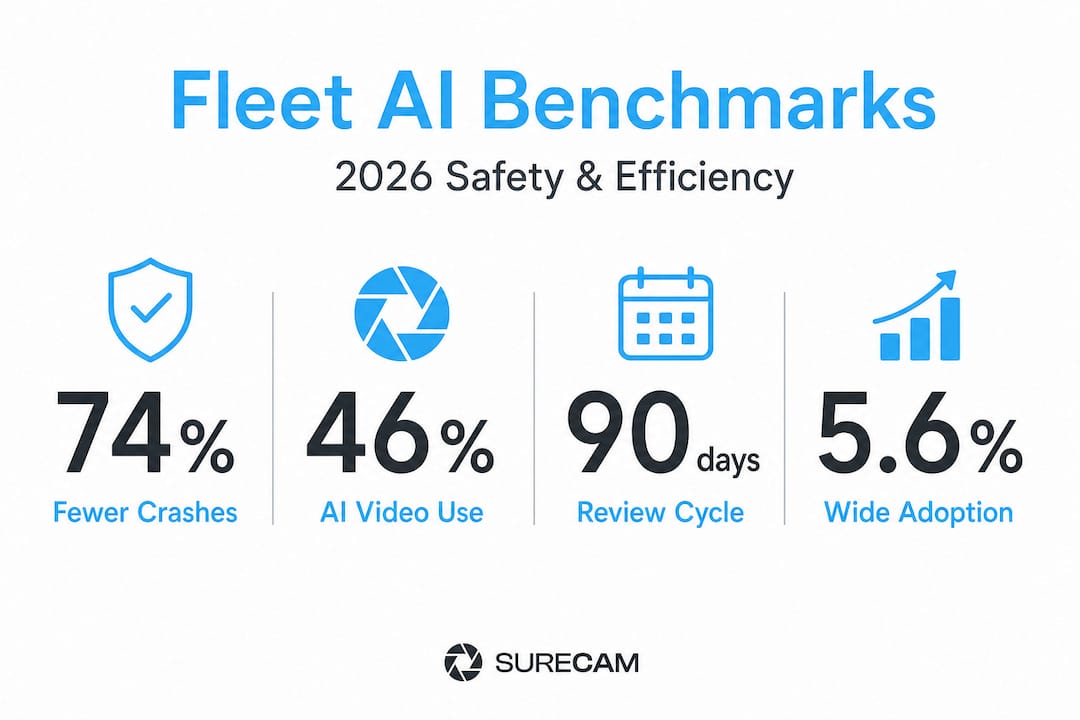
Video telematics adoption rates have reached 46% across surveyed fleets, with 74% of users reporting measurable improvements in driver safety through AI-powered behavior detection and coaching. Those numbers reflect a genuine change in how safety is managed, not just measured. Separately, AI safety solution benchmarks show significant crash-rate reductions for fleets that deploy a full AI safety stack, including in-cab alerts, event detection, and structured coaching programs.
The difference between old and new approaches is not subtle. Here is a direct comparison:
| Capability | Traditional telematics | AI-powered telematics |
|---|---|---|
| Primary function | Location and speed tracking | Behavior detection and outcome prediction |
| Safety approach | Reactive, post-incident review | Proactive, real-time intervention |
| Driver feedback | Periodic reports | In-cab alerts and coaching |
| Data output | GPS logs, mileage | Video events, risk scores, coaching completion |
| Value driver | Accountability | Crash prevention and behavior change |
"The shift is from recording what happened to preventing what could happen. That is where AI in fleet management delivers its clearest value."
Fleet managers evaluating AI dash cameras in 2026 will find that the technology has matured significantly. Systems now detect distracted driving, fatigue indicators, tailgating, harsh braking, and lane departure, then deliver instant feedback to the driver rather than waiting for a manager to review footage. This represents a structural change in how safety programs operate.
The shift also changes how you think about the purpose of video footage. It is no longer just defense against distracted driving claims after the fact. It is an active layer of driver development built into daily operations. And when organizations approach real-time driver monitoring strategically, they avoid alert fatigue and focus coaching where it generates the most measurable impact.
With the context set, let's break down how this technology transition plays out in your day-to-day fleet operations.
Operational impacts: Measuring safety and performance with AI
Understanding the tech is crucial, but the real difference comes in how these systems impact day-to-day safety outcomes and performance metrics.
AI enables real-time intervention. That distinction matters because most safety incidents are predictable. A driver who is consistently following too closely, checking their phone at intersections, or accelerating aggressively will show those patterns in the data well before a serious incident occurs. The goal of a modern safety program is to catch and correct those patterns early using both leading and lagging indicators.
Fleet safety benchmarks reinforce this point clearly. Fleets should track both leading indicators like coaching completion rates and near-miss frequency, and downstream KPIs like crash rates, insurance claims, and total cost of risk. Over-optimizing for a single metric, such as exoneration footage alone, misses the full picture. The goal is behavior change, not just evidence collection.
Here are the key metrics to build into your safety program:
Leading indicators (predictive):
- Coaching session completion rate
- Number of in-cab alert events per driver per week
- Near-miss event frequency
- Distraction event rate per 100 miles
- Seatbelt compliance rate
Lagging indicators (outcome-based):
- Crash rate per million miles
- Insurance claim frequency and severity
- Accident-related downtime in days
- Cost per claim
A practical framework for tracking performance across both categories looks like this:
| Metric type | Example KPI | Review frequency | Target benchmark |
|---|---|---|---|
| Leading | Coaching completion rate | Weekly | Above 90% |
| Leading | In-cab alerts per driver | Weekly | Trending down |
| Lagging | Crashes per million miles | Monthly | Year-over-year reduction |
| Lagging | Insurance claim cost | Quarterly | Measurable decrease |
For a detailed breakdown of how video telematics explained connect to real safety outcomes, it helps to understand the full data loop from event capture through coaching action. Similarly, organizations focused on fleet safety and insurance improvements often find that structured coaching programs tied to video evidence accelerate insurer confidence and lower premiums faster than reactive claim management alone.
Broader taxi safety tech trends in commercial transport also reflect this pattern, with operators using AI alerts and coaching to differentiate their safety culture from competitors.
Pro Tip: Set a 90-day review cycle when you launch a new safety program. Compare leading indicators in month one to lagging indicators in months two and three. That lag gap tells you whether your coaching is actually changing behavior before it shows up in claims data.
AI in fleet maintenance: Progress, pitfalls, and practical adoption
With AI taking a lead in both safety and maintenance, it is important to acknowledge the adoption challenges and focus on solid, proven strategies.
AI-powered maintenance promises to reduce unplanned downtime by predicting component failures before they occur. The potential is real. But the current state of adoption tells a more cautious story. Fleetio's 2026 Fleet Benchmark Report shows that only 5.6% of fleets use AI broadly in their maintenance operations. Meanwhile, 53.3% are still researching or piloting it. The primary hesitation is accuracy and reliability, cited by 50.8% of respondents as their main barrier to broader adoption.
Those numbers come from a dataset covering 1.2 million vehicles, 17.5 billion miles, $7 billion in service spend, and 9 million work orders. That scale gives the benchmarks significant credibility. And the picture they paint is one of an industry that is interested but cautious about AI in maintenance.
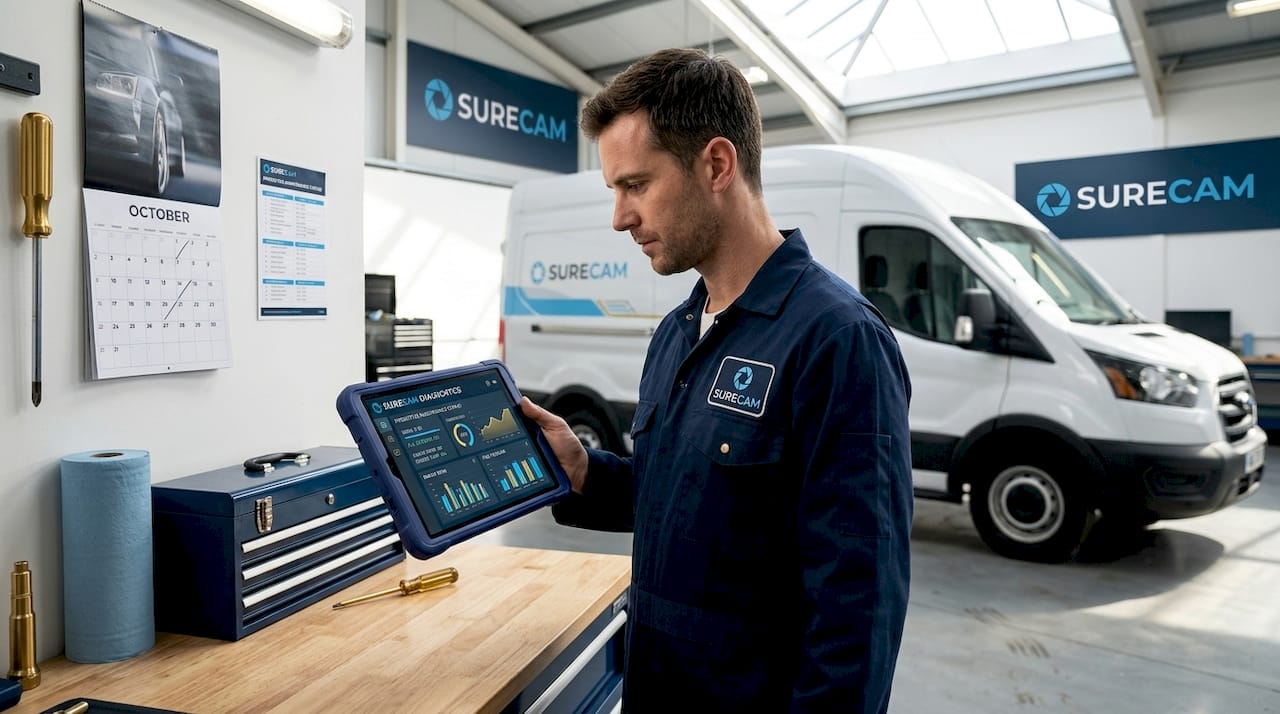
The operational baseline matters here. Currently, 30.8% of fleets still rely on spreadsheets to manage maintenance. More critically, 53.7% of maintenance work is unscheduled. Unscheduled work is almost always more expensive, more disruptive, and more time-consuming than planned maintenance. It is also where AI has the clearest opportunity to add value, by identifying patterns in vehicle data that signal an impending failure before the driver notices anything is wrong.
Key challenges holding back AI maintenance adoption:
- Accuracy and reliability concerns with AI model outputs
- Lack of integration between vehicle data systems and maintenance management platforms
- Training gaps for maintenance staff on how to interpret AI recommendations
- Cost and complexity of initial setup and data integration
- Insufficient historical data in some fleets to train reliable models
Practical steps to pilot AI in maintenance without over-committing:
- Start with a single vehicle class where failure patterns are well understood, such as a specific truck model with documented brake or tire wear history.
- Run the AI recommendation engine in parallel with your existing process for 60 to 90 days, comparing its predictions to actual failure events.
- Measure prediction accuracy before acting on AI outputs. Do not skip this validation step.
- Define a governance process: who reviews AI recommendations, who approves work orders, and how disputes are logged.
- Expand to additional vehicle classes only after the first cohort demonstrates reliable accuracy.
For fleet managers evaluating camera systems for business owners alongside maintenance tech, the key insight is that video and telematics data can also feed into maintenance workflows. Harsh braking events, for example, are both a safety signal and an early indicator of brake component stress.
Pro Tip: Rising costs are the top concern for 54.4% of fleet managers in 2026. If your maintenance AI pilot does not show a measurable cost impact within 90 days, it is worth re-examining your data inputs before expanding the program.
Fleets electrify: Tech solutions for charging, data, and grid realities
Fleet management is not just about data and process anymore. Electrification is quickly changing both strategy and day-to-day operations.
The move to electric vehicles in commercial fleets is accelerating. But the infrastructure to support that move is not keeping pace. 2026 electrification trends specifically highlight infrastructure lag and point to smart charging, vehicle-to-grid (V2G) technology, and demand-response programs as the key emerging tools to bridge that gap.
"Grid constraints are not a minor inconvenience. For utility and construction fleets operating in areas with aging infrastructure, they represent a genuine ceiling on how fast electrification can proceed."
V2G technology allows fleet vehicles to return stored energy to the grid during peak demand periods, turning EV batteries into distributed grid assets. Demand-response programs let fleet operators agree to defer charging during high-demand periods in exchange for lower utility rates. Both strategies require telematics integration to work at scale. You need to know which vehicles are plugged in, how much charge they have, and when they are scheduled to deploy.
Three steps to prepare your operation for fleet electrification:
- Conduct a route and energy audit. Map your highest-mileage routes and calculate daily energy requirements per vehicle class. Identify which routes are candidates for EV replacement based on range and charging feasibility.
- Plan charging infrastructure in phases. Do not wait until you have a large EV fleet to install charging equipment. Start with depot charging for overnight vehicles, then evaluate opportunity charging at job sites or field locations.
- Integrate telematics with charging management. Use dash cameras combined with telematics to monitor plug-in compliance, track state of charge, and flag vehicles that are not charging as scheduled. This data is essential for both operations and driver accountability.
Telematics platforms that connect charging status with GPS location and operational schedules give fleet managers real-time visibility into EV readiness. That visibility is not optional when vehicle availability directly affects job completion.
Benchmarks and barriers: Maintenance execution in the real world
While new tech sets the pace, it is the ability to execute, mid-downtime, with real vehicles and real constraints, that separates great fleets from the rest.
Even fleets with excellent technology investments can underperform on maintenance execution. The reason is usually process, not tools. Fleetio's benchmark data shows a median time-to-start of 31 minutes for work orders, with an average cycle time of 6.7 days. That gap between when a problem is identified and when work begins is a direct driver of vehicle downtime and cost.
| Execution metric | Benchmark value | Impact |
|---|---|---|
| Median time to start work orders | 31 minutes | Delays compound across high-volume shops |
| Average work order cycle time | 6.7 days | Extended downtime per vehicle |
| Unscheduled maintenance rate | 53.7% | Higher cost, greater disruption |
| Spreadsheet-dependent fleets | 30.8% | Limited visibility into trends and performance |
For fleets evaluating video telematics for smaller operations, this data is a useful calibration point. Technology alone does not solve a 31-minute work order delay. That requires workflow design, staffing alignment, and clear escalation paths.
What best-in-class maintenance operations do differently:
- They track time-to-start as a primary KPI, not just total repair time
- They use digital work orders with automated notifications to reduce manual handoffs
- They categorize every work order as scheduled or unscheduled to measure improvement over time
- They connect vehicle diagnostic data directly to work order creation to reduce data entry errors
- They benchmark their performance quarterly against industry data, not just internal trends
What most guides miss about fleet tech: Trust, integration, and disciplined execution
Most coverage of fleet technology trends focuses on features: what AI can detect, how many cameras a system supports, which platforms integrate with which. That framing misses the harder question. What actually makes a technology investment deliver on its potential?
The honest answer is trust and governance. Adoption data confirms that accuracy and reliability concerns are the leading reason fleets hesitate to expand AI use. That is not a technology problem. It is a validation and governance problem. Fleets that have successfully scaled AI tools are the ones that built structured pilots, validated model outputs against real outcomes, and defined clear decision rights for who acts on AI-generated recommendations.
The silver-bullet mentality is a real risk in fleet technology. A new AI safety platform will not fix a coaching program that managers do not actually run. A predictive maintenance tool will not reduce downtime if technicians ignore its alerts because they do not trust the accuracy. Technology amplifies good processes. It does not replace them.
Effective real-time driver monitoring programs are a good example of this principle. The fleets that get measurable results from in-cab alerts are the ones that have defined exactly which behaviors trigger coaching conversations, who has those conversations, and how outcomes are tracked over time. The technology surfaces the signal. People and process deliver the outcome.
The practical advice for 2026 is this: pick fewer tools and implement them more deeply. One well-governed AI safety program with consistent coaching follow-through will outperform three platforms with no accountability structure. Depth of execution matters more than breadth of adoption.
Ready to modernize your fleet? Explore leading solutions
If you are ready to put these technology strategies to work, you do not have to start from scratch. SureCam provides AI-powered dash cam and GPS tracking solutions purpose-built for commercial fleets in construction, utilities, and field services.
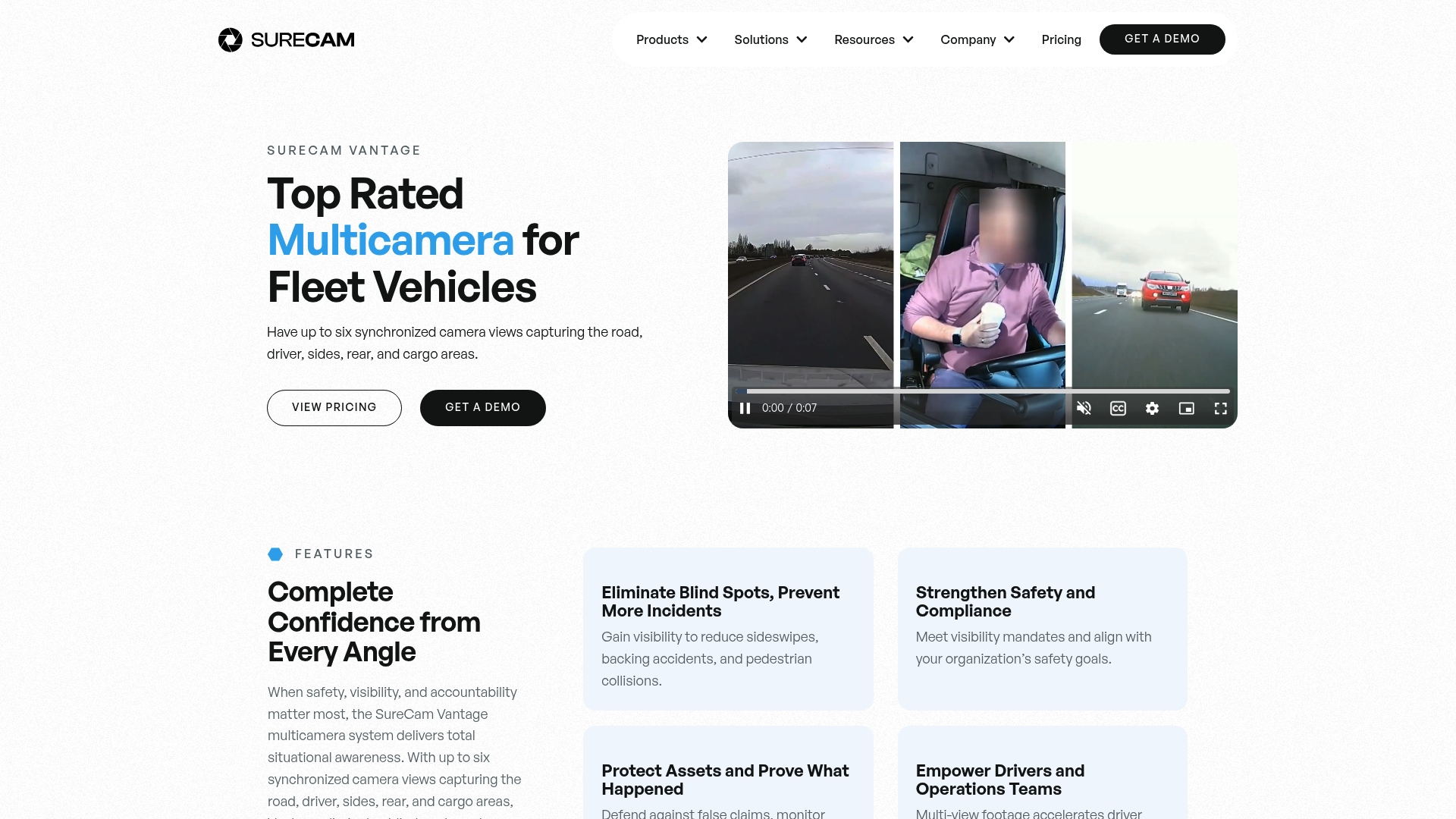
Whether you need easy fleet tracking solutions to get started quickly, purpose-built fleet dash camera solutions to activate in-cab coaching and event detection, or a fully integrated approach through dash cameras with telematics for operational visibility across your entire operation, SureCam has the right configuration for your fleet size and industry. Get a demo today to see how the platform supports measurable safety and efficiency outcomes from day one.
Frequently asked questions
What's the biggest fleet management tech trend for 2026?
The biggest trend is the move from simple vehicle tracking to proactive, AI-powered systems that drive safety and operational outcomes. Leading fleet tech coverage describes this as a structural shift from recording data to generating decisions.
How do AI safety solutions reduce accidents?
AI solutions give drivers in-cab alerts and real-time coaching, leading to improved driving behavior and significant crash-rate reductions. Benchmark data confirms measurable safety improvements when AI is paired with structured coaching programs.
Are fleets really using AI for maintenance today?
Most fleets are still testing or piloting AI in maintenance. Only 5.6% use AI broadly, while 50.8% cite accuracy and reliability as the primary reason for hesitation.
What's the main challenge for fleets going electric?
Grid constraints and charging infrastructure lag are the biggest hurdles to electric fleet adoption in 2026. 2026 electrification trends point to smart charging and V2G technology as the emerging solutions to address these gaps.
How can fleets minimize maintenance downtime?
Focus on reducing time-to-start for work orders and improving the ratio of scheduled to unscheduled maintenance. Benchmark data shows a 31-minute median time-to-start, which represents a clear and addressable gap in most fleet maintenance workflows.