
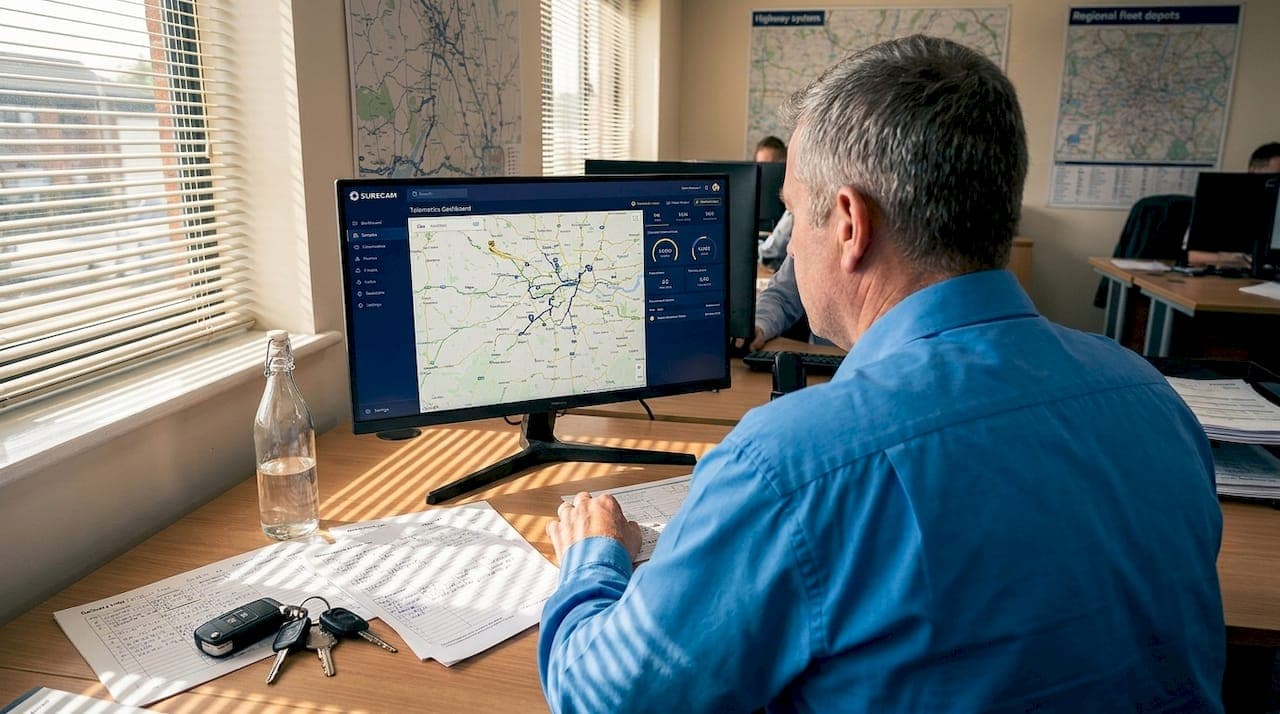
Compliance used to feel like a filing problem. You kept your logs updated, stayed current on inspections, and handled violations when they showed up. That worked in an era when regulators checked in periodically. It doesn't work anymore. The FMCSA now operates with continuous data feeds, automated scoring systems, and digital footprints that follow every vehicle in your fleet in real time. If your compliance process still runs on paper audits and after-the-fact reviews, you're already behind regulators who can see your fleet's risk profile before you do.
Table of Contents
- Why compliance risk is changing for fleets
- What telematics really means for compliance
- Comparing traditional vs. telematics-powered compliance
- Applying telematics for proactive compliance management
- The uncomfortable truth about compliance — why telematics is necessary, not optional
- How SureCam helps fleets lead in compliance
- Frequently asked questions
Key Takeaways
| Point | Details |
|---|---|
| Telematics detects compliance risks | Real-time monitoring spots violations and risky behaviors before they become violations. |
| Manual reviews are less effective | Paper-based compliance cannot keep pace with regulators’ use of digital performance data. |
| Integrity protects against penalties | Device and data integrity are required to meet FMCSA standards and withstand audits. |
| Proactive management is possible | With telematics, you can coach drivers, track issues, and prepare for audits with less stress. |
Why compliance risk is changing for fleets
The modern regulatory environment punishes slow reactions. Regulators don't wait for an annual audit cycle to flag your fleet. The FMCSA's Safety Measurement System (SMS) scores carriers on a rolling 24-month basis, pulling data from roadside inspections, state-reported crashes, and formal investigations. Those scores feed directly into seven Behavior Analysis and Safety Improvement Categories (BASICs), covering everything from hours-of-service violations to driver fitness and vehicle maintenance.
Here's what that means in practice: a single bad inspection in one state can affect your SMS percentile ranking within weeks. Carriers sitting above certain percentile thresholds in critical BASICs receive warning letters and become targets for intervention. Your CSA score basics aren't just an internal benchmark anymore; they're the metric regulators use to decide how much attention your fleet deserves.
As the FMCSA Field Operations Training Manual makes clear, compliance risk for carriers concentrates in SMS BASIC categories driven by roadside inspections, crashes, and investigations, and telematics monitoring can help fleets detect and remediate the issues that feed those scores.
The table below shows exactly which BASIC categories carry the highest regulatory weight:
| BASIC category | What it measures | Key risk triggers |
|---|---|---|
| Unsafe driving | Speeding, distraction, lane deviation | Roadside citations, camera evidence |
| HOS compliance | Falsified or missed logs | ELD edits, driving time violations |
| Vehicle maintenance | Out-of-service defects | Pre-trip failures, inspection findings |
| Driver fitness | CDL violations, medical issues | License audits, crash investigations |
| Controlled substances | Drug and alcohol violations | Post-crash testing, roadside checks |
| Hazmat compliance | Placarding and handling violations | Load audits, inspection records |
| Crash indicator | Crash history and severity | State-reported accident data |
"A fleet manager who learns about a violation at the next scheduled review is already three weeks behind the regulator who logged it at the roadside."
The digital footprint problem is real and growing. Weigh station bypass systems, electronic inspection reports, and connected ELDs all feed real-time data into state and federal systems. Your operation is being watched continuously whether or not you're watching it yourself.
What telematics really means for compliance
There's a persistent myth in fleet management circles that any device checking the compliance box is good enough. That thinking is genuinely dangerous. Telematics isn't a single product; it's an interconnected system of location tracking, speed monitoring, hours-of-service (HOS) logging, video capture, and data transmission. Each layer serves a distinct compliance function, and when they work together, they create a verifiable, tamper-resistant record of how your fleet operates.
Consider what connected devices actually capture:
- GPS location and speed data that establishes where a vehicle was, how fast it was traveling, and how long it stayed at each location
- ELD records that log driving time, duty status changes, and vehicle movement in a format regulators can audit directly
- Dash cam footage that provides visual evidence of driver behavior, road conditions, and incident context
- Accelerometer and g-force data that flags hard braking, rapid acceleration, and sharp cornering events
To see how telematics works in a fully integrated system, it becomes clear why data integrity matters as much as data collection. The FMCSA's own oversight process has real limitations when it comes to adversarial testing of devices. As FreightWaves reported, ELD compliance involves not just having devices installed but also preventing data manipulation, including ELD backdoors and unauthorized edits, because enforcement has historically struggled to catch adversarial tampering.
That's the gap compliance managers need to close. A device that allows log edits without an audit trail creates liability, not protection. A system that drops GPS data intermittently leaves holes in your defense during an investigation.
Pro Tip: When evaluating any telematics solution, ask vendors specifically about their audit trail capabilities: can every log edit be traced back to a user, timestamp, and reason? If the answer is vague, the device likely won't protect you when it matters most.
Platforms that combine dash cams with telematics give you the full picture: synchronized video and data logs that corroborate each other, making it significantly harder for disputed incidents to go unresolved.

Comparing traditional vs. telematics-powered compliance
Let's look at this directly. Traditional compliance management depends on periodic reviews, paper logs, and reactive reporting. Telematics-powered compliance runs on continuous data collection, automated alerts, and proactive intervention. The difference isn't just efficiency; it's the difference between finding out about a problem after it becomes a regulatory flag versus catching it before any enforcement action occurs.
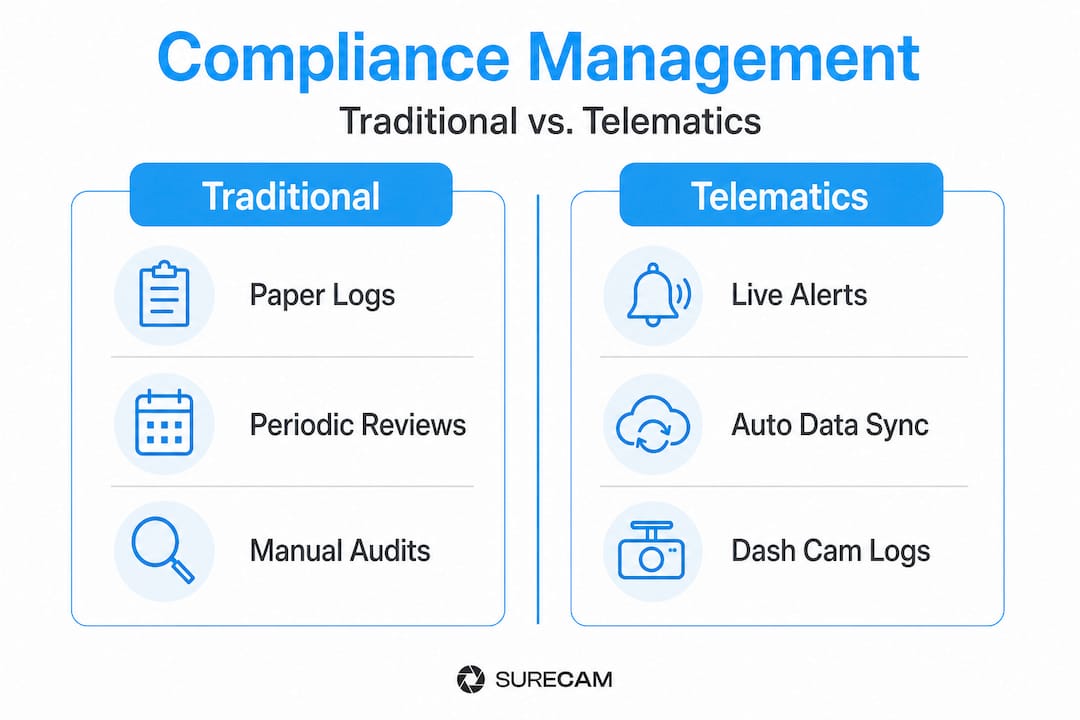
| Compliance factor | Traditional approach | Telematics-powered approach |
|---|---|---|
| HOS tracking | Paper or manual digital logs | Automated ELD with real-time sync |
| Violation detection | Post-trip review or audit | Immediate automated alert |
| Incident documentation | Driver statements and police reports | Timestamped video plus GPS data |
| Driver accountability | Supervisor review of submitted logs | Continuous behavioral monitoring |
| Audit preparation | Manual document assembly | Cloud-stored, exportable records |
| Manipulation risk | High (manual entries, erasures) | Low (locked logs with audit trails) |
The three benefits fleets consistently report after switching to telematics-based compliance:
-
Faster violation remediation. When a speeding event, HOS exception, or harsh driving incident triggers an alert, your safety team can address it the same day rather than discovering it during a monthly review. Speed of response directly reduces the likelihood of repeated violations that compound your SMS scores.
-
Defensible documentation. Video footage synchronized with GPS and ELD data creates a complete, court-ready record. When a third party claims your driver was at fault in an incident, you have objective evidence rather than a competing account. This matters enormously for improving safety with telematics and protecting your fleet's liability exposure.
-
Systematic audit readiness. Because records are stored automatically in the cloud, preparing for an FMCSA compliance review no longer means two weeks of manual document pulling. Your compliance data is always current, always organized, and always accessible to authorized reviewers.
It's worth noting that even telematics systems aren't foolproof if the underlying device oversight is weak. As noted in the ELD approval overhaul coverage from FreightWaves, FMCSA enforcement has real limitations around adversarial testing, which is exactly why device selection and data integrity protocols matter as much as device installation. For fleet managers building a holistic compliance best practices strategy, the quality of the system is inseparable from the quality of the outcome.
Applying telematics for proactive compliance management
Knowing that telematics is valuable and actually using it to prevent violations are two different things. This section is about the practical application, specifically what to monitor, what triggers to configure, and how to build the routines that keep your fleet audit-ready at all times.
What to monitor on a daily basis:
- ELD duty status exceptions and potential HOS violations flagged before the driver's shift ends
- Speeding events above configurable thresholds (for example, 10 mph over posted limits on commercial routes)
- Harsh braking, rapid acceleration, and sharp turn events that indicate high-risk driving patterns
- GPS deviations from approved routes or unexpected stops in unauthorized locations
- Vehicle fault codes and engine diagnostic data that signal maintenance compliance issues
The key insight here is front-loading your monitoring. The compliance triggers that damage SMS scores, roadside citations, crash reports, and inspection failures, almost always have precursor behaviors that show up in telematics data first. A driver with three speeding alerts in a week is statistically far more likely to receive a roadside citation. Catching it in week one means coaching before the citation. Missing it means a BASIC score impact that stays on your record for 24 months.
Automated alerts are your early warning system. Configure your telematics platform to notify safety managers when specific thresholds are crossed, not just when something goes wrong. This is how you build the coaching loop that actually changes driver behavior over time.
As FMCSA guidance confirms, telematics-enabled monitoring helps fleets detect and remediate the specific issues that feed SMS scores. That's not marketing language. That's the regulator acknowledging what proactive telematics use actually accomplishes.
Best practices for audit preparation:
- Schedule weekly data exports from your ELD and telematics systems, even when no audit is pending
- Maintain a driver-facing summary of compliance standing, updated monthly, so drivers understand their own behavioral metrics
- Cross-reference GPS data with fuel card transactions to identify unauthorized vehicle use or route deviations
- Keep video event records for a minimum of 90 days for all flagged incidents, not just collisions
- Document every corrective coaching session with timestamps and outcomes so you have a paper trail of responsiveness
When selecting the right telematics solution for your operation, verify that the platform generates exportable compliance reports in formats your safety team and external auditors can actually use. A system that stores data but can't present it cleanly under audit pressure doesn't fully solve the problem.
Statistic callout: Fleets using integrated telematics and video monitoring report significantly faster response times to compliance events compared to those relying on manual log reviews, with some carriers reducing violation recurrence rates by more than 40% after implementing automated coaching workflows.
The uncomfortable truth about compliance — why telematics is necessary, not optional
Here's the candid version of what we see from carriers who are still treating compliance as a backroom function. They're chasing violations after the fact, responding to FMCSA warning letters with corrective action plans that explain what already went wrong. That cycle is expensive, stressful, and, increasingly, avoidable.
The regulator's view of your fleet is now more current and more detailed than most carriers' internal view. The SMS updates on a monthly cycle. Roadside inspection data flows into the system within days. State crash reports feed the algorithm automatically. If you're reviewing logs quarterly and checking driver records twice a year, you're operating with a significant information lag compared to the agency that decides whether to intervene in your operation.
Telematics doesn't solve compliance by creating more reports to read. It solves compliance by making the right information visible at the right time so the right person can act on it. That's a fundamentally different operating model. It requires treating data not as a compliance artifact, something you generate to satisfy a requirement, but as an operational tool that drives daily decisions.
The fleets that have embraced connected compliance strategies aren't doing so because they enjoy technology. They're doing it because they understand that the cost of a preventable violation, when you add legal exposure, insurance impact, driver downtime, and SMS score damage, consistently exceeds the cost of proactive monitoring. Complacency with legacy methods is one of the most expensive bets a fleet manager can make right now.
How SureCam helps fleets lead in compliance
If this article has prompted you to rethink how your fleet handles compliance monitoring, the next step is finding a system that actually closes the loop between data capture, real-time alerts, and actionable driver coaching.
SureCam's integrated platform is built specifically for commercial fleets that need more than basic GPS tracking. The system combines synchronized video, real-time location data, and driver behavior analytics into a single compliance-ready solution. Automated alerts notify your safety team the moment a threshold is crossed, video evidence is stored securely in the cloud, and your records are always organized for audit access. For fleet managers focused on compliance, explore telematics for fleet managers and see how connected cameras and data work together. The dash cams with telematics options available through SureCam are designed for fleets that can't afford the gap between what's happening on the road and what your safety team knows about it.
Frequently asked questions
How does telematics data improve CSA or SMS scores?
Telematics enables fleets to quickly detect and fix driver behaviors that feed SMS BASIC categories, reducing roadside violations and lowering overall risk scores. Acting on alerts before a violation escalates to a roadside citation keeps your SMS scoring profile clean and reduces the likelihood of FMCSA intervention.
Are all telematics systems FMCSA-compliant?
Not automatically. Data integrity, tamper prevention, and full audit trail capabilities are just as critical as having devices installed, because ELD oversight gaps mean some devices on the market don't adequately prevent unauthorized log manipulation.
What are the biggest compliance risks telematics helps address?
Key risks include falsified HOS logs, missed speeding violations, unreported unsafe driving behaviors, and slow remediation of issues that directly feed SMS inspection scores. Catching these early through automated alerts is what separates proactive fleets from reactive ones.
Can telematics fully replace manual compliance reviews?
Telematics dramatically reduces the burden of manual review, but human oversight remains essential for data quality checks, handling edge cases, and ensuring your team understands what the data actually means during a formal audit. The best compliance programs use telematics to focus human attention rather than eliminate it entirely, especially since device adversarial testing gaps make system monitoring an ongoing responsibility.